Tuesday, March 28, 2017

Three Steps and Stumble... 3/20/17


Follow us!


March 20, 2017

The Markets

Three steps and no stumble...

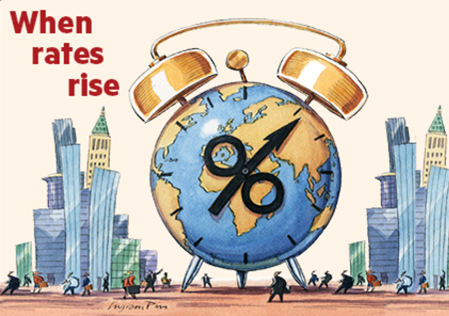
Technical analyst Edson Gould developed a market rule of thumb known as 'three steps and a stumble.' It states stock prices may fall after the Federal Reserve (Fed) raises the Fed funds rate three times in a row without a decline, according to Market Technicians Association.

The idea is three increases show the Fed is serious about keeping rates at a relatively high level for a significant length of time. Higher interest rates could potentially mean higher costs and lower profits for businesses. As a result, stock investors may sell shares and share prices may fall.

Last week, with employment and inflation data approaching Fed targets, the Federal Open Market Committee raised rates for the third time, pushing the Fed funds target rate into the 0.75 percent to 1 percent range, reported Financial Times:
"Fed policymakers' forecasts for growth and inflation remained little changed, with growth tipped to be 2.1 percent this year and next year, slipping to 1.9 percent in 2019. Core inflation is set to be 1.9 percent in 2017 and 2 percent in the two following years. The possibility of looser fiscal policy emerging from Congress has triggered speculation that the central bank will have to further accelerate its rate-rising campaign, but a number of policymakers are insistent that they want to see firmer plans emerging from Congress before making a call on the impact of possible tax cuts on the economy."
Major U.S. stock market indices finished the week higher, as did most markets in Europe and Asia. MarketWatch indicated Asian markets were encouraged by indications the Fed may not increase rates as often as expected this year, and CNBC reported European markets were boosted by a better-than-expected outcome for mainstream parties in Dutch elections.


I Spy with my Little Eye... Robots!
If you take a cruise anytime soon, the bartender may not be able to lend an ear. According to Financial Times, one cruise line has installed robotic bartenders that produce one drink per minute per arm, and can make up to 120 drinks an hour.

It's not just cruise lines, either. The food industry in the United States is automating. Financial Times described food preparation at a pizza restaurant in California:
"...Pepe squirts tomato sauce on to a pizza base before his colleague Marta spreads it; Noel has 22 seconds to correct any imperfections and add cheese and other toppings, after which Bruno takes the pizza from the line and places it in the oven. But on this production line, only Noel is human. The others - anthropomorphised by name only - are machines conducting tasks usually performed by people."
The restaurant has 75 human employees who earn about $18.00 an hour. They all are given opportunities to take coding classes so they can better understand and manage robots as well as the artificial intelligence used to evaluate delivery routes.

Then, there is Sally, a robot offered by a food robotics firm. Sally can produce "... fully-customized, fresh, and healthy salads. Sally's proprietary technology dispenses measured quantities of more than 20 ingredients - refreshed daily - to create a ready-to-eat meal any time of day." Alternate versions of this robot will offer Mexican and Indian food choices.

Competition for employees is becoming a significant issue in the restaurant industry, reported the National Restaurant Association. More than a quarter of restaurant operators, who participated in a January 2017 survey, said recruiting and retaining employees is the single most important challenge they face - a 9 percent jump from 2015. That's the highest level since October 2007.

Soon, the attraction for young children at burger joints may be watching robotic characters pull together kids' meals! 

Weekly Focus - Think About It
"There is a point in every contest when sitting on the sidelines is not an option."
--Dean Smith, Former Head Coach, University of North Carolina Tar Heels

You've Read It Before - Market Uncertainty 3/27/17


Follow us on

Weekly Market Commentary

March 27, 2017

The Market

You've read it before - and it's true. Markets hate uncertainty.

Failure to pass the American Healthcare Act, which was supported by Republican leaders in Congress and President Trump, may have spooked U.S. stock markets last week.

In an article titled, "How To Make Investing Decisions Based On Politics: Don't," Nasdaq.com reported controversy over the bill was "raising questions about [Republicans'] ability to focus on and pass policies that the market has been eagerly anticipating, such as tax reform and infrastructure spending." Financial Times concurred:

"The post-election stock market rally has been largely powered by hopes Donald Trump's administration would swiftly launch a bevy of aggressive economic stimulus measures, including tax cuts, deregulation, and infrastructure spending. However, Mr. Trump's difficulty in Congress over the government's healthcare plan has prompted some reappraisal by investors of the prospect of significant stimulus arriving later this year."

Financial Times pointed out it's likely other factors played a role in investors' decision-making, as well. Some professionals have become concerned about market valuations. About 34 percent of fund managers believe global equity markets are overvalued and 81 percent say U.S. equities are the most expensive in the world, reported Fortune Magazine citing Bank of America Merrill Lynch's survey of fund managers.

In addition, estimates for corporate earnings have been revised lower for the first quarter of 2017. Take that with a grain of salt, though. FactSet wrote, "In terms of estimate revisions for companies in the S&P 500, analysts have made smaller cuts than average to earnings estimates for Q1 2017 to date..."

Politics is one factor affecting markets, and partisanship may be affecting consumer sentiment. Richard Curtin, chief economist of University of Michigan Surveys of Consumers, said consumers' expectations about future economic growth were split along party lines in March. "...among Democrats, the Expectations Index at 55.3 signaled that a deep recession was imminent, while among Republicans the Index at 122.4 indicated a new era of robust economic growth was ahead."

We live in interesting times!

"It Ain't What You Don't Know That Gets You Into Trouble. It's what you know for sure that just ain't so," wrote Mark Twain. 

In 2016, NerdWallet commissioned a survey* to get a better handle on Americans' thoughts about lying when money is involved. It's interesting to note which money-saving lies participants found acceptable. The list included:
* Logging on to someone else's retail or media account to avoid subscription fees (33 percent)* Not reporting under-the-table income to avoid taxes due (24 percent)* Lying about your age or your child's age to receive a discount at a restaurant or retailer (21 percent)* Lying about annual mileage to lower auto insurance rates (20 percent)* Lying about income on a loan or credit card application (12 percent)* Lying about smoking tobacco to lower life insurance rates (11 percent)
(The number in the parentheses reflects the percent of those surveyed who said the lie was okay.)

The survey found far more men than women believe it is acceptable to tell lies to save money. For instance, 30 percent of men said it was okay not to report under-the-table income to the IRS. Only 18 percent of women agreed. One-fourth of male survey participants thought it was okay to fudge annual mileage to receive lower auto insurance rates, while just 16 percent of female respondents agreed.

Age also makes a difference. Americans who are age 65 or older were far less likely to find financial dishonesty acceptable:

"The survey found that 11 percent of seniors say it is acceptable to use someone else's paid account for online movies, music, or articles to save on subscription costs, compared with 39 percent of Americans ages 18-64. Just 7 percent of Americans ages 65 and older think it's acceptable to lie about annual mileage for lower auto insurance rates compared with 23 percent of Americans ages 18-64. Among all of the lies in the survey, the one that gets the most support from those 65 and older is not disclosing under-the-table income to the IRS in order to pay less in taxes - 14 percent say that's acceptable."

When it came down to it, "For all questions, retirees had the lowest rates of acceptance of lies compared with students, employees, and the unemployed." 

*The survey included 2,115 Americans, ages 18 and older, and was conducted February 
18-22, 2016, by Harris Poll on behalf of NerdWallet. This survey is not based on a probability sample and therefore no estimate of theoretical sampling error can be calculated.

Weekly Focus - Think About It 
"I believe that there is a subtle magnetism in Nature, which, if we unconsciously yield to it, will direct us aright." 
--Henry David Thoreau, American author

Monday, March 13, 2017

Rate Hike Ahead... Maybe 3/13/17


Follow us

March 13, 2017


Rate Hike Ahead... Maybe

Last week's U.S. employment report was better than expected. The United States added 235,000 jobs in February, which was a few more than economists had forecast.

It may seem counter intuitive, but the positive economic data helped push U.S. stock markets lower. The jobs report was a sign the American economy continues to be strong and indicates a rate hike may be on the horizon. Barron's reported:

"If anything, the data just confirms what we've known for a while now: The economy is growing, and one rate hike is unlikely to do much damage...There's still a strong likelihood of some sort of economic stimulus plan from the Trump administration sometime this year...But the fact that tax cuts and infrastructure projects are even being considered at a time when the U.S. economy is adding 200,000-plus jobs a month is 'unprecedented'..."

Federal Reserve (Fed) interest rate hikes affect stock markets because they make borrowing more expensive. Higher borrowing costs may reduce the amounts people and companies spend and affect companies' profitability and share values.

At the end of last week, CME's FedWatch Tool, which gauges the likelihood of changes in U.S. monetary policy, indicated there was better than an 88 percent chance of a rate hike when the Fed meets on March 15.

It's interesting to note investor sentiment has become less optimistic. Last week, the AAII Investor Sentiment Survey showed investor pessimism had reached its highest level since February 2016. Bearish sentiment increased by almost 11 points, finishing at 46.5 percent. That's significantly higher than the historic average of 30.5 percent. Bullish sentiment fell by almost eight points to 30 percent. That's below the historic average of 38.5 percent. The AAII survey is often used as a contrarian indicator.


They're All On The Pro Rodeo Circuit
They all grow corn and soybeans. They all have renowned universities. In addition, according to The Economist, Texas, Iowa, Nebraska, Mississippi, Alabama, and Michigan are likely to experience the biggest increase in tariffs - as a percent of state gross domestic product (GDP) - if and when the North American Free-Trade Agreement (NAFTA) is revised.

Under NAFTA, goods are imported from and exported to Mexico and Canada without tariffs, which are essentially taxes on imported goods. Tariffs typically increase the cost of imports, making them less attractive to consumers. This can help support the market for domestically produced goods and help protect domestic jobs and industries. Currently, the United States sends about $240 billion worth of goods to Mexico, each year, and Mexico sends even more to the United States.

The Economist's analysis measured potential increases in tariffs, in tandem with the volume of state exports to Mexico, to determine the possible impact on a state's economy. (The analysis did not include Canadian exports, even though Canada is also a NAFTA participant.) While the effect on the majority of states' economies would be relatively small, the impact on others could be more significant:
"In 2015, Iowa's farmers shipped $132M of high-fructose corn syrup to Mexico. Without NAFTA, Mexico would slap a tooth-aching 100 percent tariff on the stuff...Among this group, Texas stands out. It faces an average tariff of only 3 percent, but its exports to Mexico are worth nearly 6 percent of its GDP (compared with 1.3 percent nationally)...Michigan also fits this category. Its exports of cars and parts - many of which end up back in America - would attract tariffs averaging only about 5 percent. But, with such shipments totaling $4.1B, the bill would be painfully large."
No one yet knows how renegotiating NAFTA may affect any of the countries involved because talks are not expected to begin for several months.


Weekly Focus - Think About It 

"Making good decisions involves hard work. Important decisions are made in the face of great uncertainty, and often under time pressure. The world is a complex place: People and organizations respond to any decision, working together or against one another, in ways that defy comprehension. There are too many factors to consider. There is rarely an abundance of relevant, trusted data that bears directly on the matter at hand. Quite the contrary - there are plenty of partially relevant facts from disparate sources - some of which can be trusted, some not - pointing in different directions. With this backdrop, it is easy to see how one can fall into the trap of making the decision first and then finding the data to back it up later. It is so much faster. But faster is not the same as well-thought-out."
--Thomas C. Redman, "the Data Doc"

Monday, March 6, 2017

Grand Slam 3/6/17


 Follow us

March 6, 2017

The Markets

It was a grand slam.
Major U.S. stock markets were positively euphoric following President Trump's speech on February 28. Optimism about the new administration's pro-growth policies propelled the four major U.S. stock indices to record highs, despite a dearth of policy details, reported Financial Times.

It's hard to pinpoint exactly why stocks have moved so far, so quickly. However, it appears that mom-and-pop investors have become quite enthusiastic about the asset class according to data from JPMorgan Chase cited by Bloomberg. While institutional investors (pensions, insurance companies, etc.) have been reducing exposure to stocks, smaller investors have been loading up on shares.

CNBC reported some industry professionals, including Goldman's chief U.S. equity strategist David Kostin, believe stocks have become too highly valued. ZeroHedge.com quoted Kostin, who said:
"Cognitive dissonance exists in the U.S. stock market. S&P 500 is up 10 percent since the election despite negative EPS [earnings per share] revisions from sell-side analysts...Investors, S&P 500 management teams, and sell-side analysts do not agree on the most likely path forward. On the one hand, investors, corporate managers, and macroeconomic survey data suggest an increase in optimism about future economic growth. In contrast, sell-side analysts have cut consensus 2017E [estimated] adjusted EPS forecasts by 1 percent since the election and 'hard' macroeconomic data show only modest improvement."
Financial Times reported pessimism prevails in the bond market. One bond market professional said, "The bond market is taking a totally different view from the equity market. Blowing raspberries is a good way to put it...There's no belief that the growth agenda will be dramatic."

So, is strong economic growth ahead? Do bond investors or stocks investors have it right? Are institutional investors or mom-and-pop investors positioning themselves correctly? Only time will tell.


Don't Think So!
Tax season is upon us. That means we can all use some entertainment. While many folks dread the process of completing and filing taxes, some see it as an opportunity to test the boundaries of the system. Here are a few deductions Americans have taken that have failed to pass muster in tax court, courtesy of Kiplinger.com:

* You cannot deduct the cost of a good night's sleep. A tax preparer who worked from home escaped to a hotel because her clients were calling in the wee hours of the night and causing her to lose sleep. When she attempted to take a business deduction for the hotel expense, the tax court ruled a good night's sleep is a non-deductible personal expense.

* You cannot take a theft loss deduction for poor construction. A couple moved into their newly built dream home only to realize the builder had cut some corners. The house had some serious issues, including its foundation. The couple claimed the builder had defrauded them and took a large theft loss deduction. While taxpayers can deduct losses from a home-related theft, shoddy construction doesn't qualify.

* You cannot take a depletion deduction for bodily fluids. A woman earned $7,000 a year donating blood plasma because of her rare blood type. She took a depletion deduction, claiming "the loss of both her blood's mineral content and her blood's ability to regenerate," wrote Kiplinger. While companies that take coal, iron, and other minerals from the ground can take a depletion deduction, the tax court ruled that individuals cannot claim depletion on their bodies.

* You cannot deduct a business trip if there are no formal business meetings involved. A repo firm sponsored a trip to Las Vegas for its bank customers. The firm's employees chatted with clients about business on the way to Vegas, but no formal meetings were held. The tax court denied the deduction.

Before you get creative with your taxes, consult with a tax professional.

Weekly Focus - Think About It 
"Because of your smile, you make life more beautiful."
--Thich Nhat Hanh, Vietnamese Buddhist monk and peace activist

Monday, February 27, 2017

Once Upon a Time... 2/27/17


Follow us on...


February 27, 2017

The Markets
Once upon a time, five blind men discovered an elephant. Each man examined a different part of the elephant and formed a unique impression about the animal. One believed an elephant was like a pillar, while another decided an elephant was like a snake.

In recent weeks, stock and bond markets have been telling different stories, too.

Following a rally on Friday, the Dow Jones Industrial Average finished at a record high for the 11th time last week. Reuters reported major U.S. benchmark indices have been driven higher by optimism about tax reform, eased regulation, and increased infrastructure spending.

Both Reuters and Financial Times wrote some investors have become more cautious amidst growing doubts about the pace at which the new administration's economic policies may be achieved, as well as concerns about the outcome of European elections. These concerns are reflected in the bond market. Barron's reported:

"The market's recent advance has taken place on expectations of the reflationary impact of the Trump administration's policies...the action in global bond markets suggests something else. The 10-year U.S. Treasury yield ended the week at 2.317 percent, the lowest since late November, despite the reflation trade in stocks and expectations of a Fed hike by June, if not May. Even more startling was the slide in the German two-year yield, to minus 0.95 percent, by week's end, close to a record low, amid growing concern about France's coming presidential election. While stock investors are smiling at daily Dow records, the bond crowd seems to be hunkering down."
Who is correct? As with the folk tale about the elephant, both stock and bond markets may be right. Fiscal stimulus could boost economic growth, supporting higher stock values. However, the positive effects of a potential stimulus package are unlikely to be felt before 2018, according to Treasury Secretary Mnuchin. In the meantime, uncertainty about governments and policies at home and abroad may have investors opting for investments they perceive to be lower risk, such as U.S. Treasuries, and that could keep bond yields lower than some had expected.

The Best Inventions of 2016
Late last year, Time Magazine selected 25 inventions that "are making the world better, smarter, and - in some cases - a little more fun." Past editions have included underground parks, gluten sniffers, and the desktop DNA lab. For 2016, the list included:

Spherical tires. Intended for self-driving cars, spherical tires move in every direction, allowing cars to maneuver in new and unexpected ways. For example, a car can slide sideways into a parallel parking space. A critical difference between current tires and spherical tires is magnetic levitation. That's right. The tires hover beneath the car instead of being bolted on.
  • Levitating lightbulbs. This wireless floating lightbulb "relies on electromagnetism to levitate and spin, and on resonant inductive coupling - a technical term for wireless power transmission - to shine." The bulbs were so popular, the company created levitating clocks (with custom orbits that can be set for one minute or one year) and planters.
  • Smarter toothbrushes. The war on gum disease is never over. Dental hygiene slackers may find using these electric toothbrushes, which vibrate every 30 seconds to remind users to switch brush position, more rewarding. Next up: a more satisfying flossing experience.
  • Assistive tableware. If you have a loved one with a cognitive disability, assistive tableware may provide a mealtime solution, helping users eat more and maintain their dignity. The trick is in the design - bright colors, wide rubber bases, and easy-to-hold cups and flatware.
  • Playful prosthetics. A new prosthetic arm for children encourages play and is likely to make siblings and friends jealous. "When they need a hand, they have one. But they can replace it with any number of toy-like attachments, all of which are compatible with" a famous brand of building blocks.
It's always impressive to discover what a well-leavened blend of technology and cleverness will produce. 

Weekly Focus - Think About It 
"Their conclusion: more gender diverse companies offer similar return with lower volatility. In other words: More gender diversity, particularly in corporate settings, can translate to increased productivity, greater innovation, better decision-making, and higher employee retention and satisfaction."

--Morgan Stanley, An Investor's Guide to Gender Diversity

Wednesday, February 22, 2017

What Goes Up, Must Come Down 2/21/17


Follow us on...

The Markets
Up!
Four major U.S. benchmark stock indices closed at record highs for four consecutive days during Valentine's Day week, reported Financial Times (FT).

To date, positive corporate earnings and robust investor confidence have offset fiscal and political uncertainty and helped push U.S. stock markets higher, said sources cited by FT. With 82 percent of companies in the Standard & Poor's 500 Index reporting, corporate earnings are up 4.6 percent for the fourth quarter of 2016, and the Investors Intelligence Advisors Sentiment survey showed bullishness at a 12-year high last week, according to CNBC.com.

While bullish performance is welcome by stock investors, a Barron's article titled, 'Memo to Investors: What Goes Up Must Come Down,' listed the responses of traders at a firm whose chief market strategist asked:
"In order to stay long U.S. equities, you have to believe...what? Here are some answers: Trump's recent troubles are just the typical pains of any new administration. The Federal Reserve hikes rates twice, not three times, in 2017, and the yield on 10-year Treasuries stays at or below 3 percent. Oil prices remain stable. The Street, for once, is too pessimistic on earnings, but since analysts already forecast profit growth of 10.5 percent in 2017 and 11.7 percent in 2018, lower taxes must goose growth.
To this list, [the chief strategist] added the following: Trump doesn't introduce overtly protectionist policies. U.S. growth stays in the 2 percent to 3 percent range until Trump's economic agenda passes Congress. And no geopolitical event either increases global energy prices or dampens U.S. consumer confidence."
Stock markets may be highly valued, but the Conference Board Leading Economic Index, which was designed to determine highs and lows in the business cycle, indicates the U.S. economy is doing well. The index increased for three consecutive months (November through January). The Conference Board's director of business cycles and growth research, Ataman Ozyildirim, said, "The January gain was broad based among the leading indicators. If this trend continues, the U.S. economy may even accelerate in the near term."


Things You Didn't Know Your Cat Wanted
Cat wine didn't win the first Pet Care Innovation Prize - that went to a dishwasher-safe bowl that connects to the pet owner's phone and Wi-Fi - but the product has been in the news. Hostilities appear to have broken out between competing start-up companies that make faux wine for cats (and a few faux wines for discriminating dogs). The New York Times reported:

"But already the company that brought its products to market first...'the original cat winery' - is accusing its newer competitor...of being a copycat...Both have come up with clever names for their products: For $11.95, people can buy Fluffy an 8-ounce bottle of Catbernet or Pinot Meow...Or for $14.95, they can pour 12 ounces of Meow & Chandon...Since alcohol can harm cats, these products are essentially catnip water, which can make a cat loopy and an owner happy. But based on a wine tasting I conducted at a local cat cafe-slash-adoption center, the products are primarily catnip for the owners: The shelter cats did not like wines from either company - only two of them indulged - but the people visiting the tastings loved the concept."

The challenge for companies that want cats to enjoy their wines, according to data from National Geographic, is the active ingredient in catnip - the oil found on catnip's stems and leaves - functions as a pheromone. While humans have ingested catnip for years in teas that assist digestion or reduce tension, cats prefer to smell the stuff. That could make the bouquet of cat wine quite important. Next on the docket for the cat wine start-ups: products for the next generation - kittens.

If cat wine sounds over-the-top to you, ponder this: One of the cat wine start-ups sold half of a million dollars worth of pet wines last year.

Weekly Focus - Think About It 

"Stories matter. Many stories matter. Stories have been used to dispossess and to malign, but stories can also be used to empower and to humanize. Stories can break the dignity of a people, but stories can also repair that broken dignity. 
--Chimamanda Ngozi Adichie, Nigerian novelist

Tuesday, February 14, 2017

The Road to Brexit 2/14/17


Follow us on

Weekly Market Commentary
February 13, 2017

The Markets

What's the word 'phenomenal' worth? It all depends on who says it
Barron's shared Wilshire Associates' calculations which indicated the word was worth about $175 billion - the amount markets gained last Thursday - when President Trump used it to describe the tax plan his administration will deliver "ahead of schedule." Markets gained another $100 billion in value on Friday. Barron's reported:
"While tax reform is definitely coming, a final bill is still a long way off, and a 2017 effective date is looking less likely...Yet, as the action late last week suggests, the equity markets are more than willing to give the new administration the benefit of the doubt. Something's coming, even if we don't know what or when. And that seems good enough to bid stocks higher..."

The word 'phenomenal' is probably worth a bit less than Wilshire's estimate. United States stocks pushed higher on positive earnings growth, too. With 71 percent of companies in the Standard & Poor's 500 Index reporting results for the fourth quarter of 2016, "...the blended earnings growth rate for the S&P 500 is 5.0 percent. The fourth quarter will mark the first time the index has seen year-over-year growth in earnings for two consecutive quarters since Q4 2014 and Q1 2015."

Consumer confidence remained high, but wavered a bit in February, according to the University of Michigan Surveys of Consumers. Americans are happy with their current financial circumstances, but expectations for the future dropped sharply. Surveys of Consumers chief economist, Richard Curtin, wrote:
"... a total of nearly six-in-ten consumers made a positive or negative mention of government policies. In the long history of the surveys, this total had never reached even half that amount...These differences are troublesome: the Democrat's Expectations Index is close to its historic low (indicating recession) and the Republican's Expectations Index is near its historic high (indicating expansion). While currently distorted by partisanship, the best bet is that the gap will narrow to match a more moderate pace of growth."
This week could be bumpy. On Valentine's Day, Fed Chair Janet Yellen will testify about the state of the economy before the U.S. Senate.


On the Road to Brexit...

Last week, Members of Parliament (MPs) approved the Article 50 bill, green-lighting Britain's exit from the European Union (EU). If the House of Lords follows suit, which is far from certain, then the British government will follow the lead of the British people and invoke Article 50 of the Lisbon Treaty. (Article 50 gives member states the right to withdraw from the EU.)

The Economist reported:

"But a different sort of Brexit bill is approaching and will be harder to manage. It could yet scupper the whole process. Leave campaigners promised voters that Brexit would save the taxpayer £350m ($440m) a week. That pledge was always tendentious. But officials in Brussels are drawing up a bill for departure that could mean Britain's contributions remain close to its membership dues for several years after it leaves. In a new report for the Centre for European Reform, a think-tank, Alex Barker, a Financial Times correspondent, puts the figure at anything between €24.5bn ($26.1bn) and €72.8bn."

Michel Barnier, the EU's chief Brexit negotiator, indicated the matter of how much Britain owes must be settled before questions about Britain's future relationship (i.e., trade agreements) with the EU can be addressed, according to Bloomberg.

To date, Prime Minister Theresa May has been taking a hard line, which has roiled tempers throughout the EU. Bloomberg reported the Prime Minister's comments:

"...are elevating the likelihood that the United Kingdom leaves the bloc in 2019 without an exit deal, let alone the sweeping trade pact it seeks...The messages from the diplomats are that EU governments are preparing to enforce their line that the United Kingdom can't be better off outside the bloc than inside it and that they value safeguarding their own interests and regional stability above the need to maintain good relations with the United Kingdom."

The pending negotiations bring to mind the words of German Field Marshal Helmut Von Moltke, "No operation extends with any certainty beyond the first encounter with the main body of the enemy."

Weekly Focus - Think About It 
"What counts for most people in investing is not how much they know, but rather how realistically they define what they don't know."
--Warren Buffett, The Oracle of Omaha